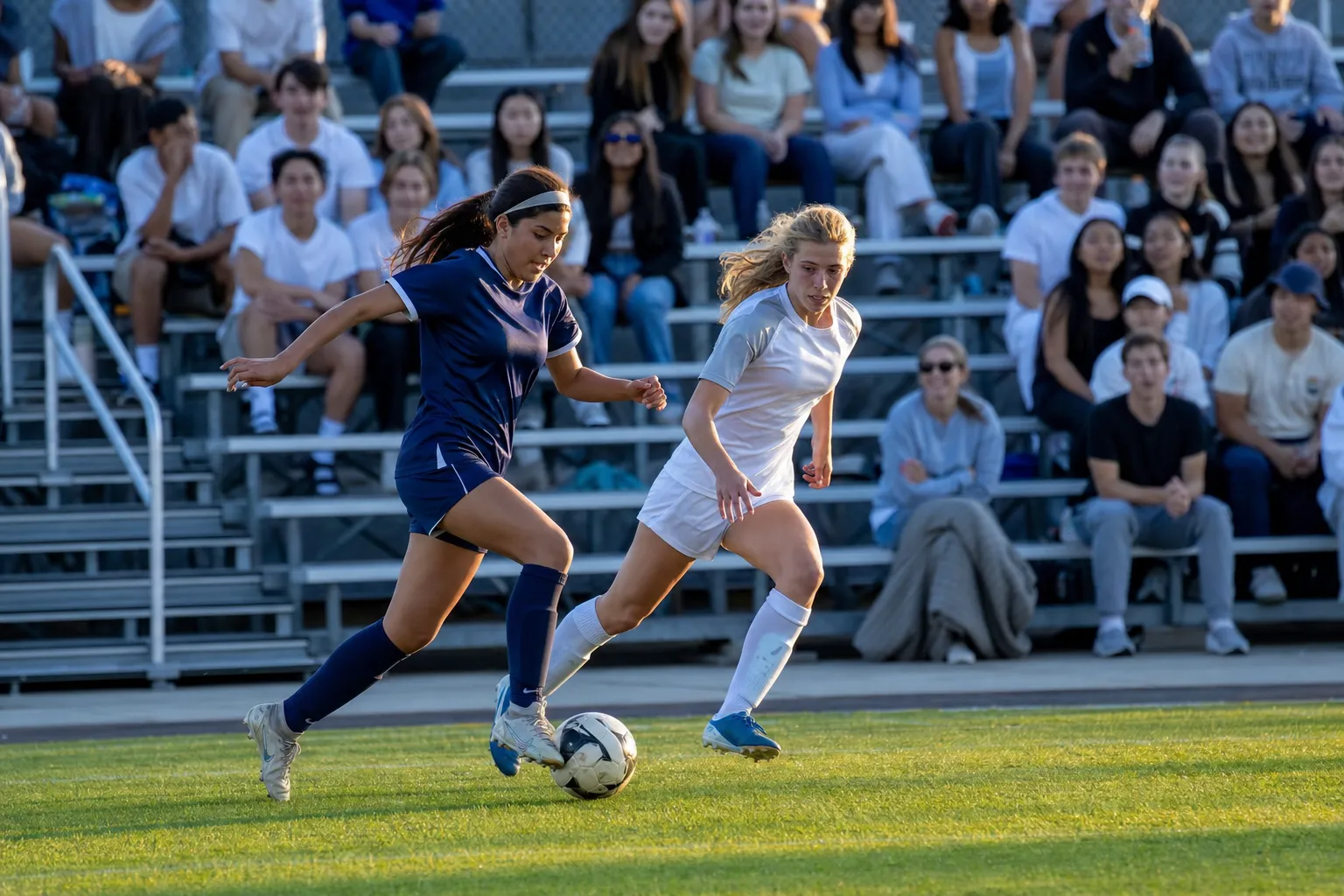
Somewhere around thirteen, a rumor reaches every soccer family: pick club or pick the school team, because you cannot have both. For almost every player that is wrong. Two separate rulebooks decide it, your club league's and your state high school association's, and families spend the argument on the first one while the second is the one that usually has something to say.
What the club leagues actually say
ECNL runs boys and girls platforms sanctioned by US Club Soccer, and for 2026-27 it lists more than 170 boys clubs and 129 girls clubs, with several hundred more in its regional leagues. Its competition rules for 2025-26 contain no restriction on high school soccer. The rule that limits where a registered player may appear, the Club Loyalty Rule at 2.11.1, says in its own text that it applies only to competitions sanctioned by US Soccer, and high school soccer is not one of those. The single mention of high school in the whole document is an accommodation for eighth graders playing down during their school season.
The Girls Academy states it outright. Its published technical standards say "High School Competition is permitted." One caution on that: the newest edition the GA puts in public is 2022-23, so if your daughter is being offered a GA place, ask the club to confirm it against the current standards.
The National 1 League is the platform that absorbed the NPL and the USYS National League for 2026-27, which puts a large share of state and regional travel teams under one rulebook: its operators announced it at roughly 10,000 teams. Its 2026-27 handbook says nothing about high school soccer either, apart from the same eighth-grade accommodation at rule 5.6.
Then there is MLS NEXT, which is where the rumor comes from, and where the answer is genuinely complicated. MLS NEXT runs no girls league, so this part is a boys' question only.
The MLS NEXT rule, division by division
MLS NEXT has two tiers, and they do not have the same rule.
The Academy Division, the second tier that launched in 2025-26 and holds roughly 230 clubs, permits it. The league's own division page says "Academy Division players are permitted to participate in high school soccer, offering a unique balance between top-tier competition and local play."
The Allstate Homegrown Division, the upper tier holding every MLS academy, restricts it, and only for one kind of roster spot. Its 2025-26 rules and regulations say "Primary Players must agree to forgo participating simultaneously in both (1) MLS NEXT Homegrown Division and (2) high school or middle school soccer." A Primary Player is the league's term for the top players at a club, the ones expected to be registered only with the Homegrown Division. Two things sit alongside that sentence in the same document. There is a High School Waiver the league can grant that lets a Primary Player do both, with application windows that for 2025-26 closed on 9 September 2025 for the fall and winter school seasons and ran from 1 January to 13 February 2026 for the spring. And there is a second roster category: "Future Players are permitted to participate simultaneously in both (1) MLS NEXT Homegrown Division and (2) high school soccer." A Future Player is defined as a rostered player who is not yet ready to contribute at Homegrown Division level full time.
So the question to ask a club that offers your son an MLS NEXT place is not "does MLS NEXT allow high school". It is: which division, which roster category, and if it is a Primary spot in the Homegrown Division, has this club ever applied for the waiver and when does the window close. Those rulebooks are reissued every season, so ask the club to show you the current one. The MLS NEXT and ECNL comparison goes through the rest of that decision.
The rule most families actually hit is their state's
Whether a player may appear for a club team while the school season is running is decided by the state high school association, not by any soccer body. The NFHS, the national federation those associations belong to, writes the playing rules for high school sports; eligibility is each state's own. The states do not agree with each other, and the differences are large.
Illinois is the strict version. The IHSA's eligibility summary for the 2025-26 school term tells the student directly: "During the time you are participating on a school team in a sport at your high school, you may neither play on a non-school team nor compete in non-school competition as an individual in that same sport or in any skill of that sport." A player who does compete elsewhere during the season and then wants to join the school team is not eligible for it.
Michigan's 2025-26 soccer rules supplement says the Limited Team Membership rule "prohibits students from competing with non-school teams in the same sport during the high school season," and names the penalty: a student who plays a club event after starting high school practice is out for at least the next three dates of competition, with a second violation likely ending the season. The same document says the MHSAA has made exceptions for girls soccer because the club and school seasons overlap in the spring.
Ohio sets a date instead of a blanket ban. Its 2026-27 soccer regulations require a player who is not playing for the school to stop non-interscholastic soccer by Monday 7 September 2026 to stay eligible for the OHSAA tournament, and a player who has played for the school and then turns out in a club match is ineligible for that tournament.
New Jersey is the other end. The NJSIAA soccer regulations contain no bar on also playing club soccer. What they do set is a workload cap: no more than three halves in a day and nine in a week, and a player must appear in at least half the school's games to be eligible for the state tournament.
Read your own state association's soccer regulations before you plan a season around both. They are published, they are usually a few pages, and they are the document that settles this.
What you are weighing, if you do have to choose
The scale is worth knowing. In 2024-25 there were 484,908 boys and 393,048 girls in high school soccer, counted by the NFHS participation survey and carried into the NCAA's probability report, against 28,746 men and 31,200 women on NCAA rosters across all three divisions. The NCAA works that through to a rate: about one high school boy in seventeen reaches an NCAA roster of any kind (5.9%) and about one girl in thirteen (7.9%). Reaching Division I specifically is about one boy in seventy and one girl in thirty-six.
Beyond that, we are into advice rather than evidence, so take it as advice. Nobody publishes a measurement of where college recruits get found, or of what a season of school soccer does to a player's development, and any page that gives you a percentage on either has made it up.
What we would ask, in this order:
Ask your child. Would missing the school season feel like a loss, or would it barely register? They will tell you, and it is the input that gets skipped.
Ask what the club spot actually is. A Future Player place in the Homegrown Division and a Primary place are different offers with different rules attached, and only one of them forces the question.
Ask about minutes. A bigger role in a lower league is time on the field. A place on a stronger roster where your child plays ten minutes a week is not.
Ask about the load. Some states let a player do both by rule and the calendar still says no. New Jersey caps a player at three halves in a day and nine in a week, which is a fair description of what a teenager's legs can take.
The short version
Almost nobody has to choose. ECNL, the Girls Academy and the National 1 League publish no high school restriction. MLS NEXT's Academy Division permits high school soccer, and its Homegrown Division restricts it for Primary Players only, with a waiver route and a Future Player category that is not restricted at all. The rule that is more likely to bite is your state high school association's, and it varies from a flat ban to no bar at all.
If you want to see where your child sits on the ladder right now and what the next decision looks like, the Pathway Report maps it with real clubs near you.
Where these numbers come from
- MLS NEXT Homegrown Division Rules and Regulations, 2025-26. Section VII.c for the Primary Player restriction, the High School Waiver and its windows, and the Future Player permission. Section I for the definitions of both roster categories.
- MLS NEXT Academy Division. The Academy Division's high school permission, and its size.
- ECNL Competition Rules, 2025-26. Rule 2.11.1 for the Club Loyalty Rule and its scope, rule 2.9.2 for the eighth-grade accommodation.
- Girls Academy Technical Standards, 2022-23. "High School Competition is permitted." This is the most recent edition the league publishes openly.
- ECNL, club pathway movement for 2026-27 (12 May 2026) and US Club Soccer, first round of National 1 league operators (27 Feb 2026). Platform sizes.
- National 1 League Handbook, 2026-27 (updated 31 March 2026). Rule 5.6 for the eighth-grade accommodation, and the absence of any other high school clause.
- IHSA student-athlete eligibility rules, 2025-26 school term. Section 10, playing in non-school competition.
- MHSAA Boys and Girls Soccer Rules Supplement, 2025-26. Limited Team Membership, the penalty, and the girls spring exceptions.
- OHSAA Soccer Sports Regulations, 2026-27. The non-interscholastic participation date and the tournament penalty.
- NJSIAA Soccer Regular Season Rules, 2025-26. Halves per day and week, and the 50% appearance rule for the state tournament.
- NFHS. What the national federation writes, and what it leaves to the state associations.
- NCAA Research, Estimated Probability of Competing in College Athletics and the NCAA Sports Sponsorship and Participation Rates Report. The high school and college participation counts, 2024-25.