A showcase and an ID camp get talked about as one line item on the recruiting budget. They are different events, run by different people, with different rules attached, and the rules are the part that decides whether either one is worth the drive.
An ID camp is run by the college, and that changes what it can be
An ID camp is a camp held by one college's own coaching staff, usually on that campus, where the players are seen by the staff who recruit for that program.
The rule families most need to know about them is this: an NCAA member college's camp or clinic must be open to any and all entrants, limited only by number, age, grade level and gender (D1 Bylaw 13.12.1.3). The camp is not allowed to select who comes. So an invitation, a "we would like to see you at our camp" email, a personalized registration link, none of that is evidence a coach is interested in your child, because the camp could not have excluded them anyway.
The second rule shapes what can happen once you are there. At Division I, a coach may not hold a recruiting conversation with a camper before August 1 of junior year (Bylaw 13.12.1.5.1). A tenth grader at a D1 camp can be watched and coached and cannot be recruited at it. Division II removed its communication restrictions in August 2024, Division III has no recruiting calendar and neither does the NAIA, so at those levels a conversation can happen at any age.
Put together, those two rules give you the question to ask before you pay: is the staff recruiting my child's graduation year and position, and are they allowed to talk to us at this event.
What it costs, in published numbers
Colleges publish camp prices, so check the camp page rather than a rule of thumb. Two priced for 2026, one at each end of the division scale, both land in the low hundreds. Baylor's summer ID camp on 20 June 2026, run by the head coach of a Division I women's program, is $195. The University of Scranton, Division III, ran four men's ID clinics in 2026 at $115 each. Those are the entry fees only, before the tank of gas or the hotel night.
For scale on what families spend across a whole year, the Aspen Institute's 2024 national survey of youth sports parents puts soccer families at $126.80 a year on camps and $237.27 on travel and lodging for their child's primary sport. Read that as a floor rather than a budget. It is a whole-population figure that mostly describes recreational and school players, since only 15.2% of the soccer families in that survey were in a travel or club setting, and a single recruiting weekend can cost more than the year it reports.
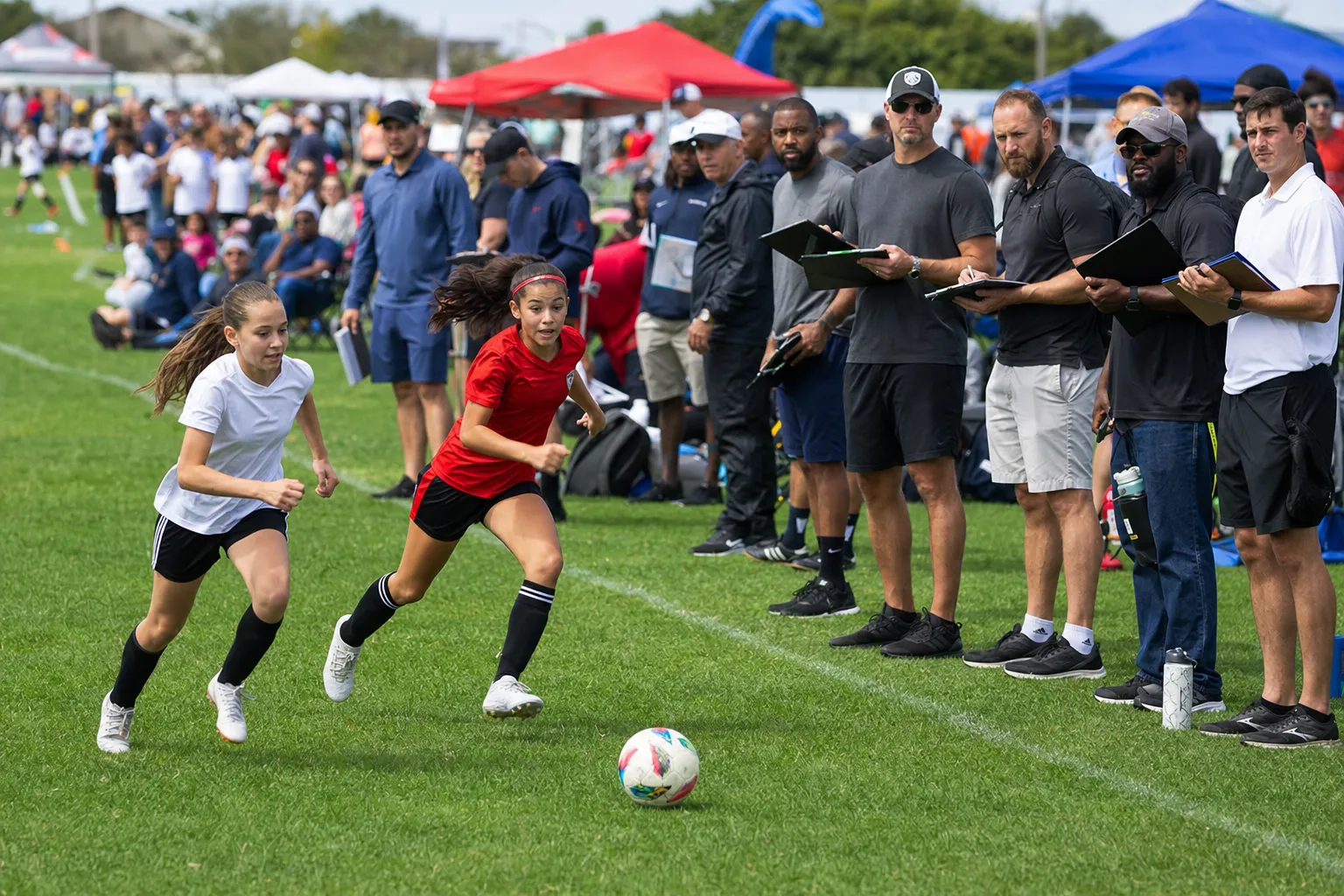
A showcase is a tournament that college coaches are invited to
A showcase gathers many teams in one place so coaches can see a lot of players in one trip. The sales pitch is the size of the coaching turnout, and the numbers in that pitch come from the events themselves.
ECNL says of its 2026-27 schedule that its top girls showcases "averaged more than 1,000 scouts each" and that its top boys events drew "more than 500 coaches". MLS calls MLS NEXT Fest the largest youth scouting event in the country and reported "over 500 professional, national team, and college coaches" at the 2025 edition in Arizona. Both are leagues counting their own events, with no published method and nobody auditing them. Treat them as what a league says about itself. Nobody publishes college placement or coach attendance by youth event in any form you could check.
What is checkable is how the recruiting rules work at an event, and they favor preparation over attendance. Soccer has no NCAA contact and evaluation period grid of the kind football and basketball run; the D1 calendar is a few dead and quiet periods around signing dates and the championships, and coaches are otherwise free to watch off campus whenever they like. But off-campus contact with your child does not open until August 1 before junior year at D1 (Bylaw 13.1.1.1), and June 15 preceding junior year at D2. Before those dates a coach standing on your child's sideline can watch and cannot approach.
So the value of a showcase is decided before you register. Email the coaches on your child's list, tell them the event, the team, the field and the kick-off times, and ask whether they will be there. A coach who answers "yes, I will look for number 8 on Saturday morning" has changed the weekend from a lottery into an appointment.
If the event falls inside the high school season
If the camp or showcase falls inside your child's high school season, the state high school association may have something to say about it.
Ohio requires a soccer player who is not playing for the school to stop non-interscholastic soccer by a fixed September date to remain eligible for the OHSAA tournament, and offers a one-time waiver per season to attend a college identification camp, which its regulations define narrowly as an individual workout or camp run by a college and not any other showcase or non-school competition. Michigan's soccer rules supplement bars competing with non-school teams during the high school season, and since 2020-21 has allowed a girls soccer player to play in scrimmages at up to two college ID camps during the spring season, provided the camp is at that college's facility and run by that college.
Both of those are permissions with a counter on them. Read your own state's soccer regulations before you enter an event that overlaps the school season.
Where the money is usually better spent
Our read, as advice: the events worth paying for are the ones a specific coach is attending, for a program your child could get into and would play at. The rest buys proximity to coaches who are not looking for your child.
That points the budget in a particular order: the camps at the two or three schools genuinely at the top of the list, the showcases where a coach has confirmed they will be there, and a campus visit, where an actual conversation happens. A seventh event with nobody expecting your child is the line item to cut.
Two related pieces cover the parts around this. The how to get recruited guide has the outreach sequence, and the college recruiting timeline has the year-by-year version of the contact rules.
Before you register
Five questions, and the answers should mostly be yes:
Is a coach from a school on our list attending this specific event? Have we been in contact with them, and have they said they will look for our child? Is the level of the event right for where our child actually plays? Is our child's grade year one this staff is allowed to talk to at this event? If it falls in the high school season, does our state association permit it?
If the answer to "will the right coaches see my child and know to look" is "I hope so", the money buys more somewhere else.
If you want a read on where your child sits on the ladder and what level of college program is a realistic target, the Pathway Report places them with real clubs near you.
Where these numbers come from
- NCAA Division I Manual. Bylaw 13.12.1.3 for camps being open to any and all entrants, 13.12.1.5.1 for no recruiting conversation with a camper before August 1 of junior year, 13.1.1.1 for off-campus contact.
- NCAA Division II Manual and the D2 Coaches Off-Campus Recruiting Guide, 2025-26. D2 communication open at any time; off-campus contact and official visits from June 15 preceding junior year.
- 2025-26 Division I Recruiting Calendar, other sports. Soccer's calendar is dead and quiet periods only, with no contact and evaluation grid.
- Baylor summer ID camp and University of Scranton ID clinics. Published 2026 camp prices.
- Aspen Institute, 2024 National Youth Sports Parent Survey. Annual soccer spending on camps and on travel and lodging, and the share of soccer families in a club setting.
- ECNL 2026-27 event schedule and MLS NEXT Fest 2025. The coach attendance claims, as published by the leagues about their own events.
- OHSAA Soccer Sports Regulations, 2026-27 and the MHSAA Boys and Girls Soccer Rules Supplement, 2025-26. The two state rules on attending college camps during the school season.