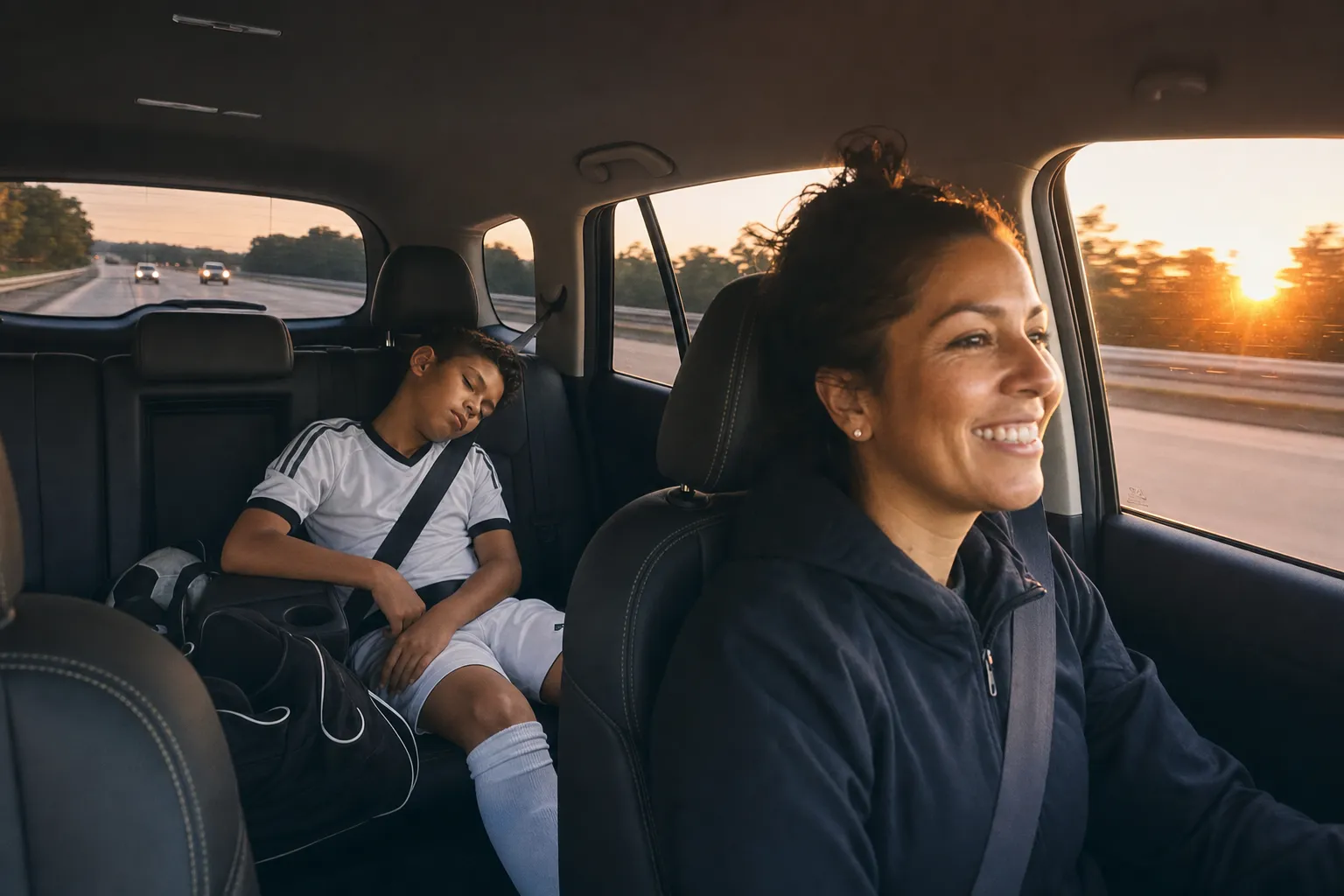
The schedule is the part nobody measures. There is no published count of practices, games or miles for travel soccer teams, at any level, from any governing body or survey. What is published is the calendar the leagues themselves run, and that turns out to answer the question better than an average would.
The figure everyone quotes, and why it is not yours
You will read that travel means three practices a week. No source measures that. The closest thing is the Aspen Institute's 2024 survey of 1,848 parents, where soccer families reported 2.42 days a week of coach-led practice, 1.67 days of games, and 5.46 months of scheduled soccer a year.
Only 15.2% of those soccer families were in a travel, elite or club setting. So 2.42 describes a group that is mostly town rec and school soccer. A travel team sits above it. Nobody publishes by how much, and we are not going to guess a number for you.
Season length does climb with age in that survey: 4.99 months at ages 6 to 10, 5.80 at 11 to 14, 6.09 at 15 to 18, with coach-led practice days going 2.27, then 2.84, then 3.01. Across the whole sample, 20.5% of children play 9 to 12 months a year.
What the leagues publish about their own calendars
This is the useful part, because a league's own season structure is a document you can read before you commit.
The top boys competition runs almost the whole year. MLS NEXT describes its Allstate Homegrown Division as a "10-month pro-style season" across U13 to U19. Its December event, MLS NEXT Fest, ran 4 to 15 December 2025 in Mesa, Arizona, with 1,474 teams from more than 250 clubs. That is a flight and a week of hotel nights in the middle of the school term, for every club that qualifies.
ECNL runs a full seasonal year and a large event calendar. Its competition rules set the season from 1 August to 31 July. Its 2026-27 schedule release counts more than 60 regular-season events in the year, of which 13 are what it calls recruitable events for ECNL and 12 for the ECNL Regional League.
"Regional" does not mean the travel stops. The ECNL Regional League ran five 2026 playoff events, in Norco California, Fort Worth Texas, Browns Summit North Carolina, St Louis Missouri and Somerset New Jersey, which ECNL says are "geographically set for teams to manage travel". From those, 40 boys teams and 40 girls teams went on to national finals, the boys in Richmond Virginia and the girls in Seattle Washington, both 15 to 18 July. A league with "regional" in the name finishes with a cross-country flight in the middle of July for the teams that get there.
The Girls Academy states its shape in one line: "League play begins in August and culminates with the playoffs and national finals events in June and July."
None of that is a weekly hour count. It is better than one, because it is the actual set of dates your family would be planning around, and each league publishes its own.
What the money says about the driving
Registration is not where the travel cost lands. In the Aspen survey, a soccer family spent $910.22 on their child's main sport across the year, and the largest single line was travel and lodging at $237.27, ahead of registration at $209.66. Getting to the games cost more than signing up for them.
Clubs say the same thing in their own words. Of the 2,686 clubs in our catalog that publish a price list, 1,730 also print what the fee does not cover: 368 of them (21%) name travel or hotels and 567 (33%) name tournament entry. If a club tells you travel is excluded, that is the club telling you where the rest of your year goes. The level-by-level fee numbers live in what club soccer costs.
The load numbers that do exist
Two bodies publish something you can hold a schedule against, and neither is a rule.
US Soccer's Player Development Initiatives carry best practices, labelled explicitly as not mandated, for the small-sided formats that run through U12: two to three training sessions per game played, no more than one game a day, a minimum of two rest days a week in season plus planned breaks across the year, travel held to no more than an hour away at 7v7 and to day trips at 9v9, and events that "provide a predetermined number of games with no advancement, placement games or champions". At 4v4, which covers U6 to U8, it goes further: travel "limited as much as possible" and no tournaments, showcases or festivals at all.
Read that next to a U10 tournament three hours away and you have the gap between what the federation recommends and what the calendar does.
The American Academy of Pediatrics adds the recovery side in its clinical report: at least one to two days off a week from the sport, and at least three months off across the year, taken a month at a time. It also cites two injury thresholds, both of which it says still need validating: risk rose above 16 hours a week of training in high school athletes, and in younger athletes playing more hours of organized sport per week than their age in years. A ten-year-old doing more than ten hours a week is past that flag.
Weekend games back to back with school on Monday is the pattern those numbers are about. Early specialization and burnout has the rest of what the research does and does not establish.
Get the club's actual calendar, not the average
The number that matters is your team's, and it exists, because last season already happened. Ask for it.
- "Can I see the full schedule this team played last season?" A promise about this year is a forecast; last year's schedule is a record.
- "How many trips needed a hotel, and how far were the longest three?"
- "Which events are mandatory, and what happens if we miss one for a family reason?"
- "How many games in a single weekend, and are there back-to-back days?"
- "What are the dates of the postseason, if we get there?" This is the one families miss, because a league's finals in mid-July land in the middle of a booked vacation.
A coach who answers those with dates is easier to plan around than one who answers with reassurance. To see which clubs sit inside a drive you would actually make, browse the club finder and filter by distance.
Where these numbers come from
- Aspen Institute, 2024 National Youth Sports Parent Survey with Utah State University and Louisiana Tech, 1,848 parents surveyed in late 2024. Days a week and months a year for soccer families, the share of those families in a travel or club setting, the season-length figures by age, and the $910.22 spending split.
- MLS NEXT, Allstate Homegrown Division and 2025 MLS NEXT Fest. The 10-month season and the December event's dates, location and size.
- ECNL, 2026-27 event schedule and ECNL Regional League playoffs. The event counts, and the playoff and finals locations and dates.
- Girls Academy, About. The August to July season shape.
- US Soccer Player Development Initiatives (2017). The 4v4, 7v7 and 9v9 best practices on training-to-game ratio, rest days, travel distance and events, all of which the document states are recommendations rather than requirements.
- American Academy of Pediatrics, Sports Specialization and Intensive Training in Young Athletes, Pediatrics 2016, reaffirmed 2021. Days and months off, and the two training-volume thresholds.
- Our own catalog of more than 10,000 US soccer clubs, of which 2,686 publish a price list. The counts of clubs naming travel, hotels and tournament entry as outside the fee.