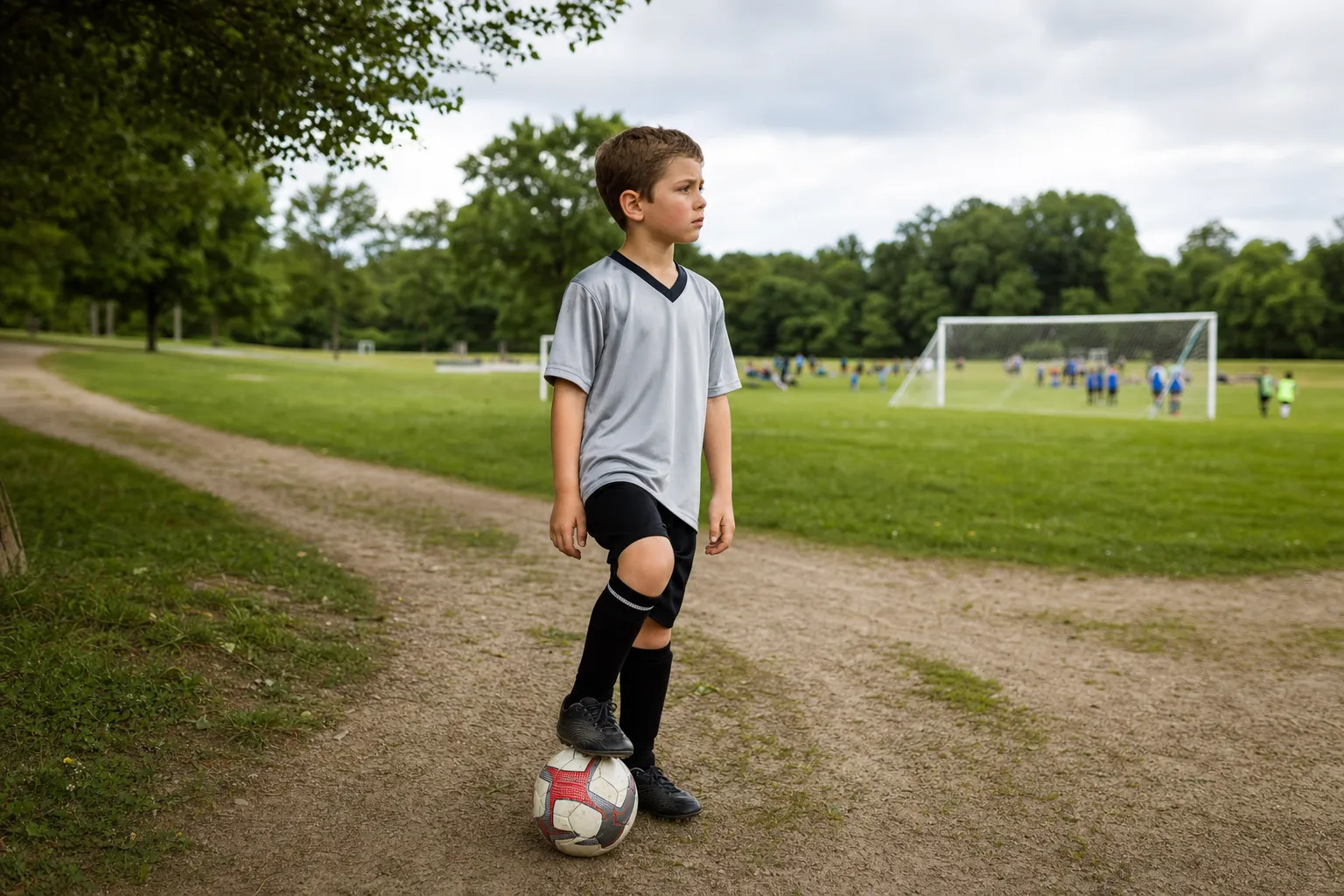
The difference between rec and travel is not how good the players are. It is who is allowed in. Recreational soccer takes every child who signs up. Travel soccer holds a tryout and cuts a roster. The money and the calendar follow from that one rule.
What rec guarantees, in writing
Rec is defined by rules rather than by a standard of play. The clearest published version belongs to AYSO, one of the national organizations that register American youth players, and its Core program runs on six philosophies. Three of them are the ones a parent feels:
- Open Registration. Interest and enthusiasm are the only criteria. There are no elimination tryouts and nobody is cut.
- Everyone Plays. Every player plays at least half of every game.
- Balanced Teams. Teams are re-formed each year as evenly as possible, so your child gets new teammates rather than a permanent ranking.
Not every town program is AYSO, and the ones that are not set their own rules. But US Soccer points the same way for the youngest ages. In its Player Development Initiatives it recommends, as best practice rather than as a requirement, that every player gets at least half of each game, that 7v7 teams play no more than 20 games a year, and that results and standings are not recorded at all in the small-sided formats its standards cover, which run through U12.
Rec is also the cheap end by a wide margin. Across 608 clubs in our catalog that publish a rec price, the median is $123 a season (club dues, before uniforms). Almost all of those prices are printed per season rather than per year, so a child who plays fall and spring pays it about twice.
What travel asks for
First, a tryout. Of the 5,764 clubs in our catalog with a site we hold, 3,514 say something about tryouts, and trying out is usually free: among the clubs that name a tryout cost, 342 say it costs nothing and 156 charge a median of $25. The tryout costs you a Saturday. Accepting the place is what costs money.
Then the fee. Comparing what clubs publish on their own price lists:
| Median published dues | |
|---|---|
| Rec | $123 a season (608 clubs) |
| Entry-level travel | $900 a year (127 clubs) |
Call it seven times the rec fee, and that is the step that changes a household budget. Everything above entry-level travel is a smaller jump than this first one, and the costs guide has the level-by-level numbers.
Dues are also not the bill. Uniforms, tournament entries and hotels sit outside them, and in the national spending survey travel is a bigger line for soccer families than registration is.
The practice-and-games question nobody can answer
You will read that travel means three practices a week and games every weekend. No published source measures practice and game counts for travel teams separately from rec teams, and we do not hold that data either. What exists is a whole-population figure. In the Aspen Institute's 2024 survey of 1,848 parents, soccer families reported 2.42 days a week of coach-led practice, 1.67 days of games, and 5.46 months of scheduled soccer a year. Only 15% of those soccer families were in a travel or club setting, so that is the average across a population that is mostly rec and school soccer. A travel team will sit above it. Nobody publishes by how much.
The number to get is not the national average. It is the club's own calendar. Ask for the practice nights, the number of tournaments, and how many of those need a hotel, before you accept a place.
Who ends up in travel
A minority of soccer families, and not a random minority. In that same survey, 15.2% of soccer families played in a travel, elite or club setting, against 53.0% in community-based programs. Across all sports, club participation ran 13.0% for households under $50,000 and 25.8% for households over $100,000. Club soccer sorts partly on money, which is worth knowing when the decision feels like a verdict on your child.
There is no deadline, and the data shows the ramp
Travel does not fill up at nine. In the 24 competitive leagues we index, the number of teams almost quadruples between U9 and U13:
| Age group | Teams | Clubs fielding one |
|---|---|---|
| U9 | 987 | 197 |
| U10 | 1,597 | 275 |
| U11 | 2,812 | 496 |
| U12 | 2,703 | 540 |
| U13 | 3,901 | 846 |
That measures the leagues we track rather than every team in the country, and part of the growth is that more leagues run at older ages. It still means there are several times more teams to join at 13 than at 9.
The research on early starts points the same way. A meta-analysis of 51 studies covering 6,096 athletes, including 772 of the world's best, found that adult world-class athletes had done more multisport practice as children, started their main sport later, accumulated less practice in it and progressed more slowly at first than athletes who topped out at national level. The pattern reversed among youth athletes: the ones winning at 12 had started earlier and practised more. Early advantage and eventual excellence are not the same measurement.
The American Academy of Pediatrics reaches a similar conclusion in its clinical report on specialization, and it is worth reading its advice as written. Playing multiple sports at least until puberty lowers the risk of injury, stress and burnout. For most sports, specializing later, in late adolescence, "may lead to a higher chance of the young athlete accomplishing his or her athletic goals". On the training itself the report is blunt about what is unknown: "The exact amount of training needed to succeed has not been described."
The counterpoint, from parents rather than from data
Nobody measures how hard it is to get in at each age, so take the next paragraph as what experienced soccer parents say rather than as a finding.
Getting a place at eight or nine is easy in a way it stops being later. At that age the bar at a lot of clubs is close to whether a child watches the ball, and teams are being built from whoever turns up. By eleven or twelve the same club is choosing between kids who have had two or three years of coaching, and a child who has played only rec can be a long way behind on the things a tryout is actually looking at, without being a worse prospect. The teams exist, as the table above shows. The competition for a place in them is a different question, and it gets stiffer.
That argues for going early if your child wants to, and it argues for nothing at all otherwise. The cost of joining early is the specialization risk in the research above, plus a real bill starting several years sooner. A child who is keen at eight loses very little by starting then. A child who is not is far more likely to quit than to be permanently locked out, and the doors do reopen: rec players join travel at eleven and twelve every season.
The 70% figure you have seen everywhere
Someone will tell you that 70% of kids quit sports by 13. That number cannot be sourced. The AAP's own report repeats it and cites, as its authority, a trade paperback. Researchers at the Aspen Institute and Lasell University traced it back nearly four decades and found what they call citation drift, a chain of secondary sources pointing at each other with no study at the end. CDC survey data has shown more than half of US high school students playing organized sports every year since 2000, apart from the pandemic. One of those researchers offers the correction that actually fits the evidence: it is not that most kids quit sports by 13, it is that kids quit most of their sports by 13. Children try several, then narrow to the one or two they want to keep. That is a different event, and a normal one.
What is measured is more useful anyway. In the Aspen Institute's 2025 survey of 3,827 children aged 10 to 17, the average age a former player stopped was 12.93, and a third of everyone who quit did so at 12, 13 or 14. Asked why they play, the top two answers were having fun (48%) and playing with friends (47%), while earning a college scholarship was named by 12%. Asked why they stopped, the two answers at the top were feeling "not good enough" (29%) and bad coaching (21%).
Read those two lists together before you decide. The most common reason a child gave for stopping was concluding they were not good enough, and moving a kid up to a team where they sit on the bench is one way to teach them that.
How to read your own kid
This part is judgment, not evidence. Nobody has measured what happens to the specific child who moves up at nine instead of eleven. What follows is how we would think about it, and you know things about your child that no study covers.
Signs the move is likely to go well: they are the one asking, they practise on their own without being told, they are visibly bored at rec, and they can take a coach's correction without it ruining their week.
Signs to give it another season: the push is mostly yours, the week is already full, they love playing but dread the pressure, or the money would come out of something the family cannot spare. Waiting is a real option with no known penalty attached to it, and we would take a child who turns up at 12 wanting to be there over one who turned up at 8 and is done by 13.
The AAP's guidance on load is worth applying either way: at least one or two days off a week from the sport, and at least three months off across the year, taken a month at a time. If a club's calendar cannot accommodate that, you have learned something about the club.
Choosing the first travel club
Go local for the first one. A club twenty minutes away that you can get to on a wet Tuesday beats a better-known one an hour up the highway, and you will be making that drive all season. Watch a practice before you write a check, since the coach is the thing you are actually buying. Ask what playing time looks like for a new player at the bottom of the roster, and ask for the full year's cost rather than the registration line. The choosing-a-club guide covers the rest, including the questions clubs answer badly.
Where these numbers come from
- AYSO Core. The six philosophies, the Everyone Plays half-game minimum, and Open Registration with no tryouts and no cuts.
- US Soccer Player Development Initiatives (2017). The small-sided best practices, which are explicitly recommendations and not requirements.
- Our own catalog of more than 10,000 US soccer clubs. Published fee schedules taken from clubs' own price lists, how many clubs publish tryout information, and team counts by age group across 26,680 team-seasons in 24 competitive leagues.
- Aspen Institute, 2024 National Youth Sports Parent Survey with Utah State University and Louisiana Tech, 1,848 parents surveyed in late 2024. Days per week and months per year for soccer families, the share of families in each setting, and the split by household income.
- Aspen Institute, 2025 National Youth Athlete Survey, 3,827 children aged 10 to 17, surveyed October to December 2025. The average age of quitting, and the children's own reasons for playing and stopping.
- Güllich, Macnamara and Hambrick, What Makes a Champion?, Perspectives on Psychological Science 2022. The meta-analysis of 51 studies on early specialization and world-class performance.
- American Academy of Pediatrics, Sports Specialization and Intensive Training in Young Athletes, Pediatrics 2016, reaffirmed 2021. Multisport participation until puberty, specializing in late adolescence, days and months off, and what the report says is not known.
- USA TODAY, 70% of kids drop out of sports by 13? Why the ubiquitous stat is wrong (April 2026). The tracing of the 70% figure and the CDC participation trend.