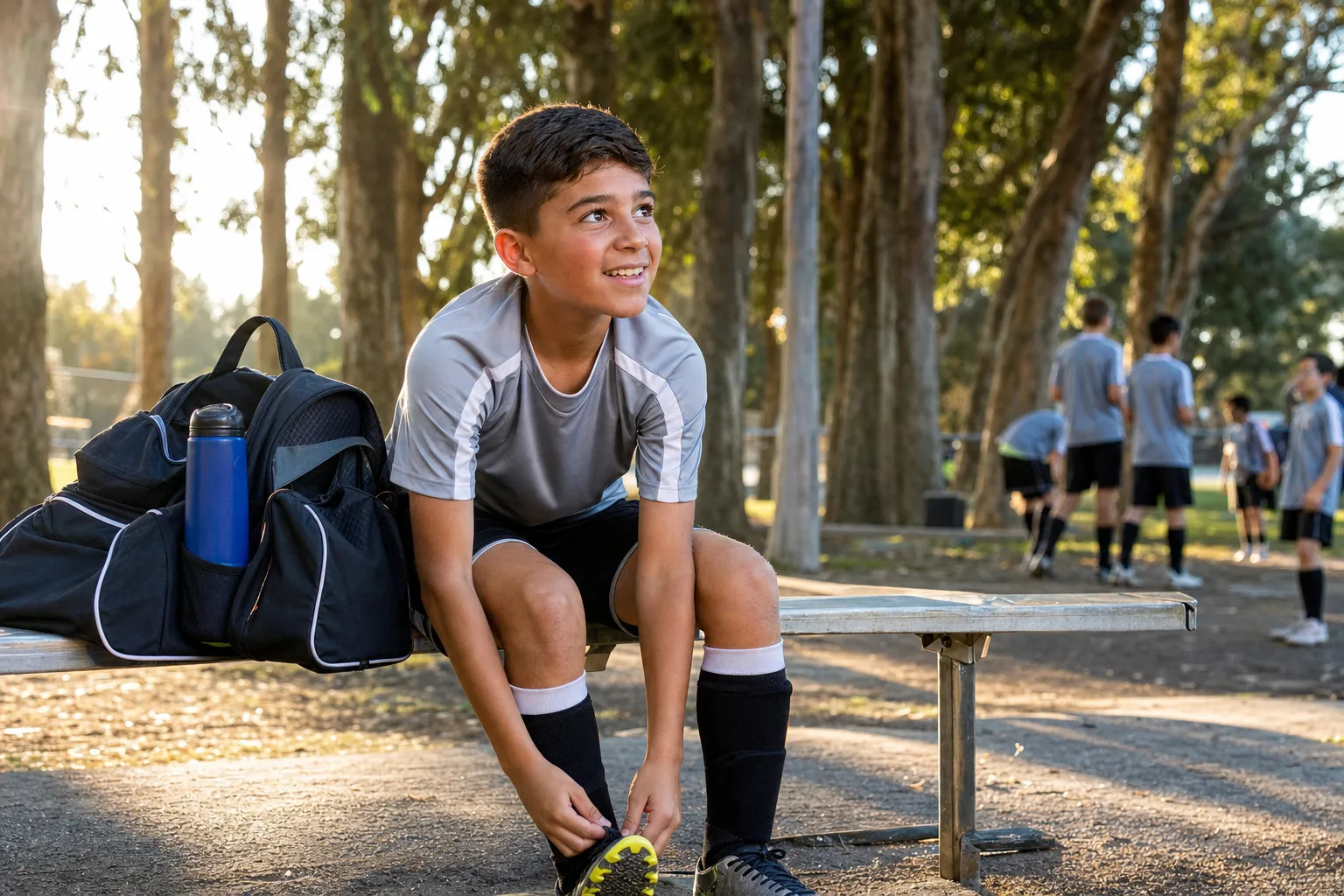
Most of what a family can control before a tryout has nothing to do with soccer. The skill is what it is by then. What is still moveable on the day is whether your child arrives rested, on time, with the right kit, and not carrying your nerves.
Two notes on what follows. Nobody publishes what a club coach scores at a tryout, so the preparation advice here is our judgment, not a finding. The evaluation side of it, including the one written framework that does exist in American soccer, is covered in what coaches look for.
The one piece with research behind it: your own behaviour
The Aspen Institute's 2025 national survey of 3,827 children aged 10 to 17 asked children about their parents. The differences between the children still playing and the children who had quit are large:
- Being pressured to play when they did not want to: 21% of former players, 9% of current players.
- Being compared to other players: 18% of former players, 13% of current players.
- Having a parent who attends games or practices: 86% of current players, 58% of former players.
The gap is wider for girls. Female former players were about twice as likely as male former players to say their parents compared them to other players (25% against 9%), pressured them to play (24% against 16%), or argued with coaches or referees during games (13% against 6%).
This is a survey of children who play sport, not a study of tryout days, and it measures a difference rather than proving a cause. It is still the closest thing to evidence any parent gets on this: turning up and staying quiet is on the side of the children who kept playing.
Sleep, and the rest of the logistics
The American Academy of Sleep Medicine's consensus recommendation, endorsed by the American Academy of Pediatrics, is that children aged 6 to 12 sleep 9 to 12 hours a night and teenagers 13 to 18 sleep 8 to 10. It is worth protecting the week of a tryout, not only the night before.
The rest is ordinary and still worth writing down, because it is what goes wrong:
- Eat a normal meal a couple of hours ahead, and bring water. Tryout day is not the day to change anything about food.
- Arrive early enough to walk in calmly. Rushing in late means checking in during the warm-up, which is the part a coach watches without meaning to.
- Bring cleats, shin guards, water, a ball if the club asked for one, and layers for the weather. Check the club's own note for anything else it wants.
- Let them warm up properly, so the first drill is not the warm-up.
- Know the cost before you go. Trying out is usually free: of the clubs in our catalog that state a price, 342 say it costs nothing and 156 charge, at a median of $25.
Extra training the week before does not buy anything
Families often book a session or two in the run-up. The American Academy of Pediatrics looked at the wider version of that question and reported that no study of sports-enhancement programs teaching technique or conditioning has shown a greater chance of success, "despite their increased time and financial investment".
That is about programs over a season rather than one session on a Thursday, and the smaller version is easier still: a tired child who has been drilled all week is worse on Saturday, not better. Keep the normal training, keep the normal week.
What we would actually say to the kid
Advice, from parents who have stood there:
Name the two things they control. Compete hard and try the thing the coach asks. Both are fully inside a nine-year-old's power. "Play well" is not.
Say the outcome does not change anything at home. Say it before, not after, when it sounds like consolation.
Then stop talking about it. A tryout that dominates the family week arrives feeling enormous.
Do not coach from the sideline. It adds pressure in front of the person deciding, and it tells the coach the player is used to being told what to do.
Do not lobby. Talking to a coach mid-session about your child rarely helps the child.
One tryout is one afternoon
A tryout is a short look at one player by one adult who is also watching everyone else. US Soccer's own scouting framework treats development as non-linear, with players progressing at different rates, and identification as a long-term process rather than a verdict on a day.
Places are also capped by rule. A 7v7 roster is 12 players under US Soccer's best practice, and US Youth Soccer's national policy caps any team roster at 22. Some of the children who do not get a place were close and the room ran out.
If the answer comes back no, what to do next covers the first 24 hours and the practical path after it.
Where these numbers come from
- Aspen Institute, 2025 National Youth Athlete Survey, 3,827 children aged 10 to 17 across all 50 states, surveyed October to December 2025. The parent-behaviour differences between current and former players, and the split by gender.
- American Academy of Sleep Medicine, child sleep duration recommendations, endorsed by the American Academy of Pediatrics. The 9 to 12 hours and 8 to 10 hours figures.
- American Academy of Pediatrics, Sports Specialization and Intensive Training in Young Athletes, Pediatrics 2016, reaffirmed 2021. That sports-enhancement programs have not been shown to raise a young athlete's chance of success.
- US Soccer, Talent ID FAQs. Development being non-linear and identification being long-term.
- US Soccer Player Development Initiatives and US Youth Soccer's Policy on Players and Playing Rules. The roster caps.
- Our own catalog of more than 10,000 US soccer clubs. What clubs charge for a tryout.